Notice windows expire
Changed work is recognized after contractual notice periods have already closed.
ScopeLedger tracks changed work from field direction to commercial decision—so notices go out inside the contractual window, evidence is organized before it is needed, and leadership can see open exposure across every project.
Scope leakage rarely begins with one dramatic failure. It begins with ordinary field decisions that never become a complete commercial record.
Changed work is recognized after contractual notice periods have already closed.
Instructions, RFIs, photographs, logs and costs live across email, phones and job trailers.
Field teams perform the work before commercial teams can assemble defensible support.
Leadership cannot see open value or evidence quality across the active portfolio.
Notices are recreated manually, weakening consistency and losing version history.
Set four operating assumptions. The calculator estimates the annual value exposed to weak notice and documentation—not your legal entitlement or guaranteed recovery.
Directional planning estimate based solely on the figures entered. A reliable assessment requires reviewing actual contract terms and change-order records.
Share your work email. We will arrange a no-cost review of one active project’s change-order history.
A controlled five-stage record replaces the disconnected trail of calls, emails and spreadsheets.
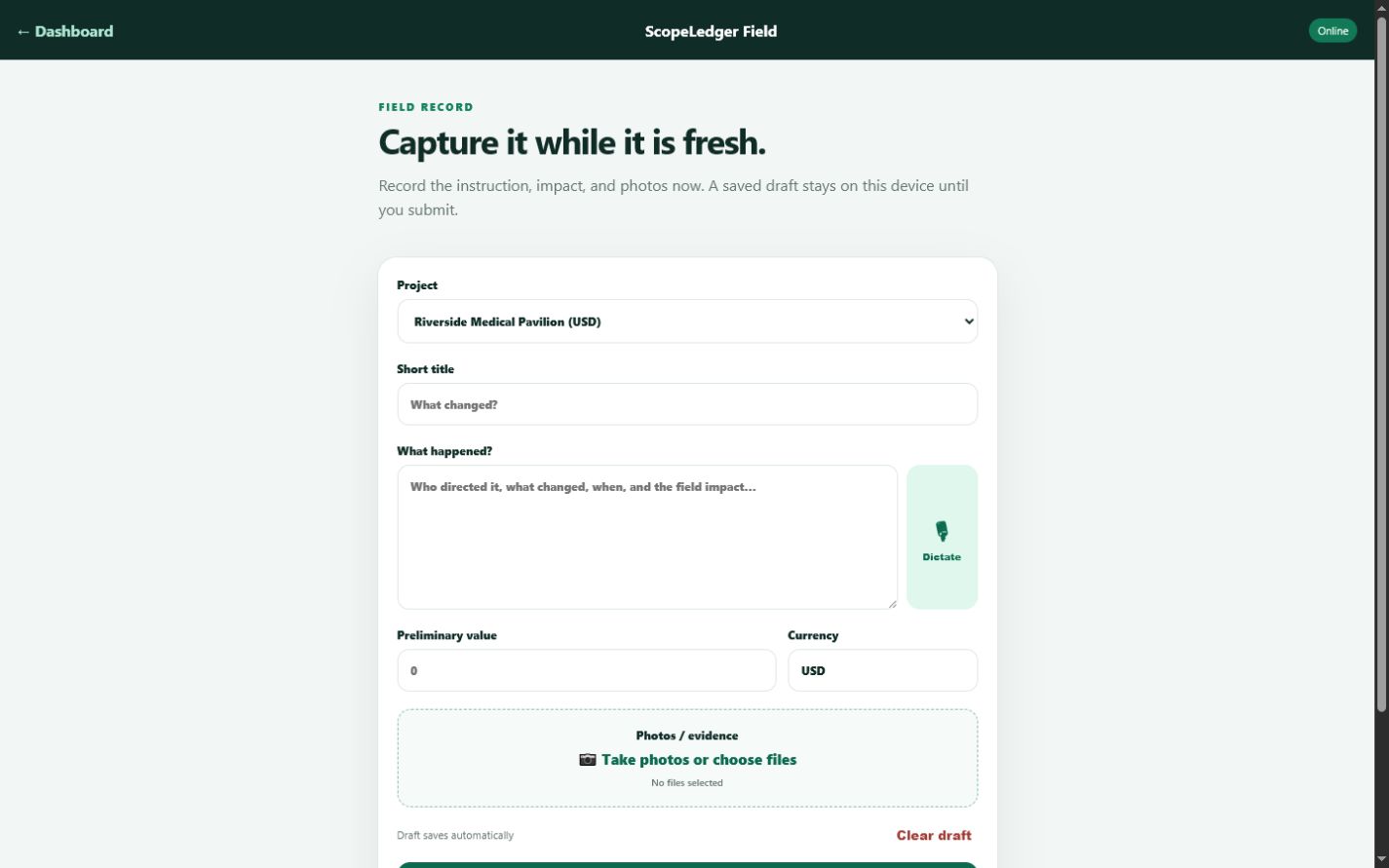
Capture who gave the direction, what changed and when.
Surface recoverability indicators, confidence and missing evidence.
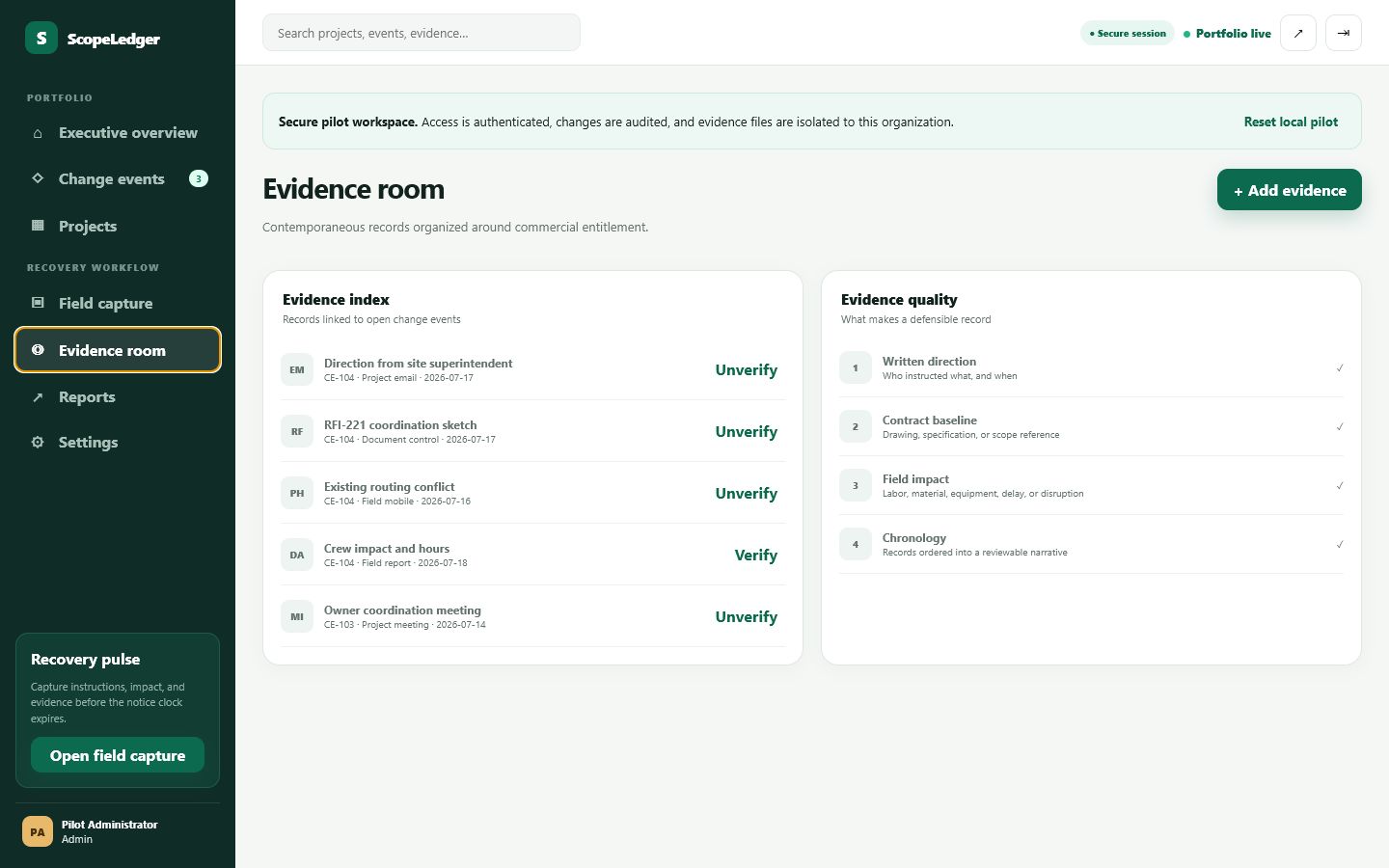
Organize written direction, baseline, field impact and cost support.
Generate a reviewed notice draft and retain every version.
Follow submission, decision and exposure across the portfolio.
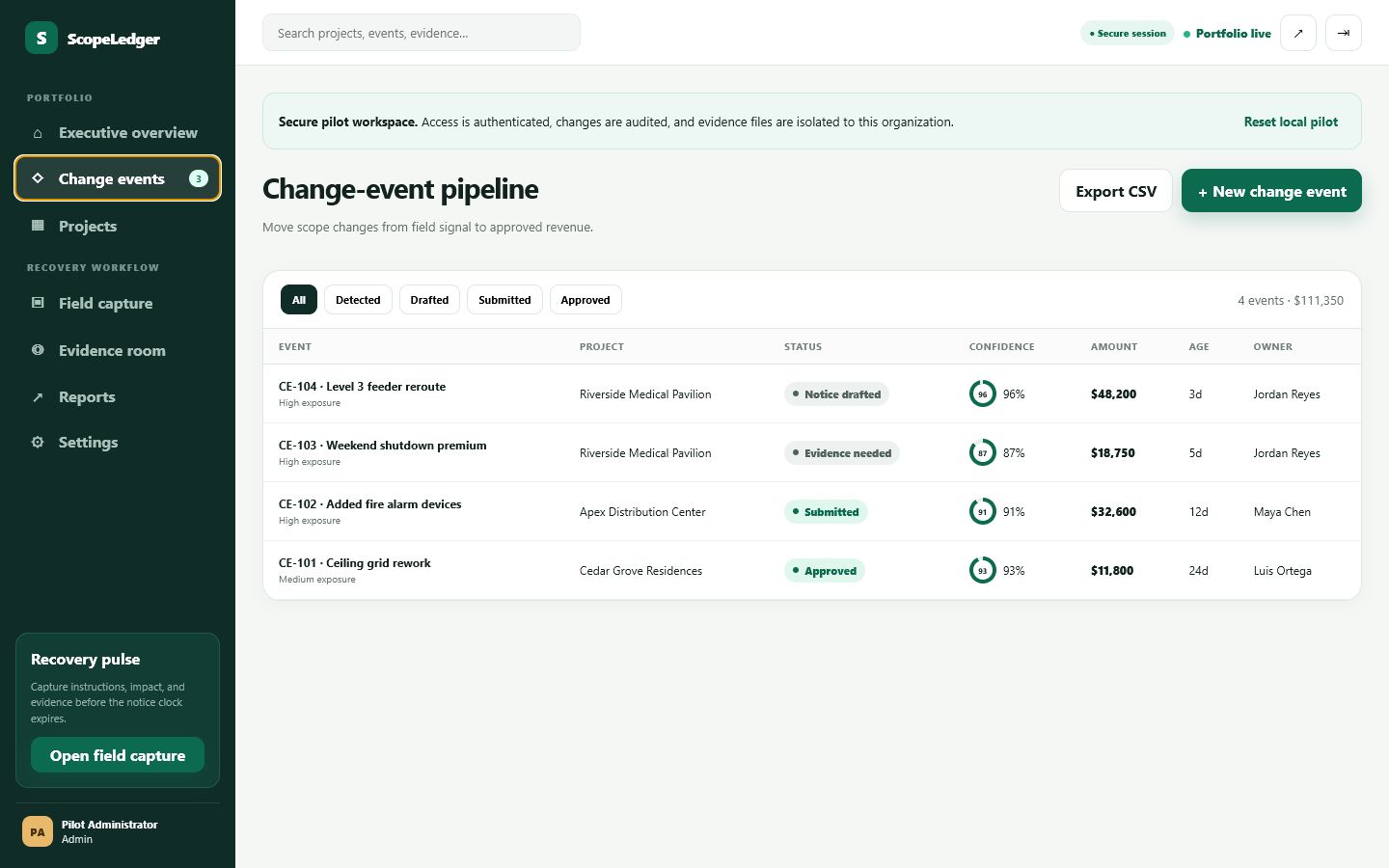
The interface makes deadlines, evidence quality and recovery value visible at the moment decisions are made.
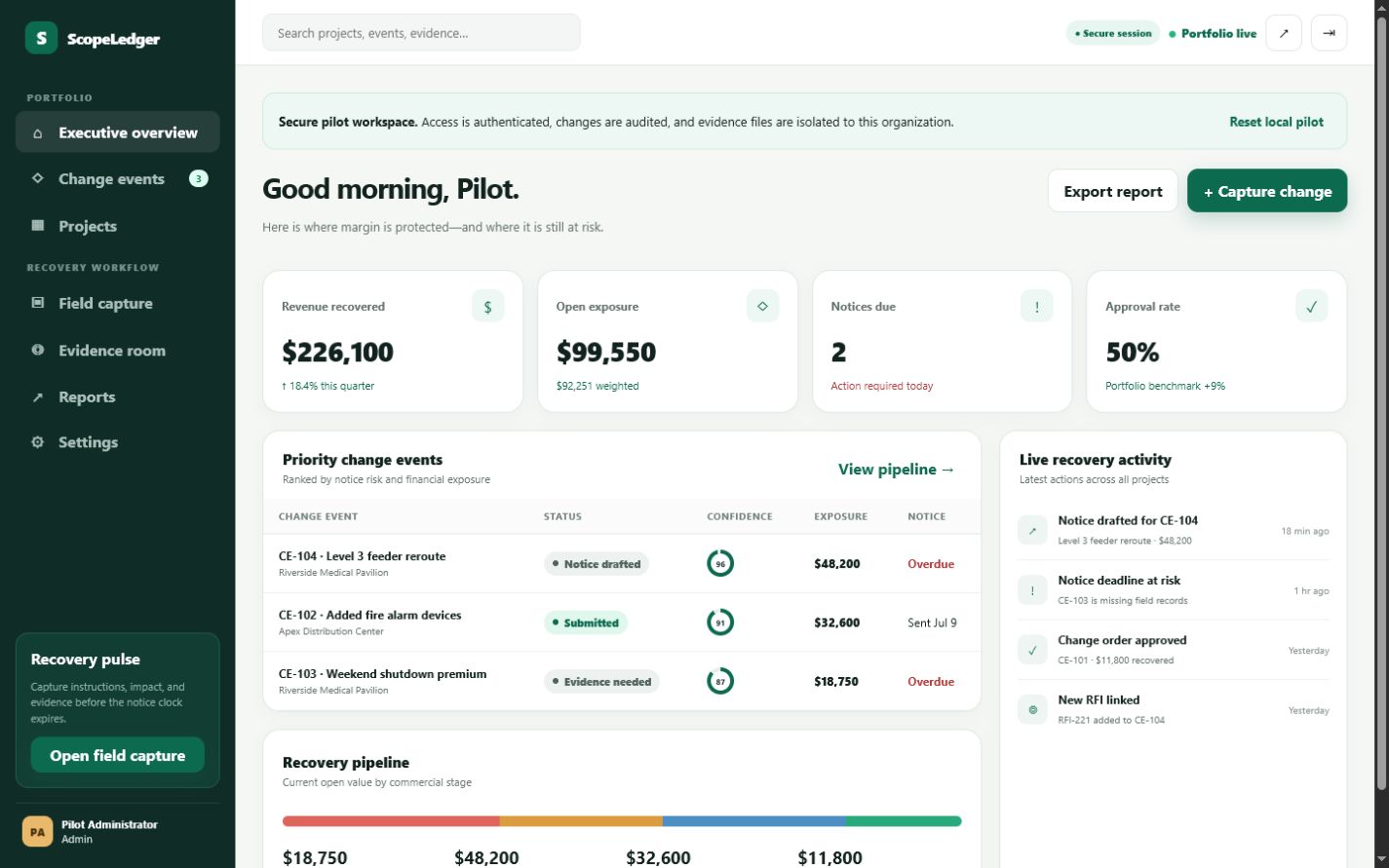
Contract values, managers, progress and project-specific notice windows in one commercial view.
Portfolio contextStructured capture with value, status, owner, deadline, confidence and recoverability indicators.
Controlled workflowEncrypted uploads, checksums, chronology, verification and controlled download.
Evidence integrityCustomer-approved reservation language, recorded facts, version history and PDF workflow.
Human-reviewed outputOpen and weighted exposure, approval rate, completeness and notice-cycle reporting with CSV export.
Decision visibilityUser roles, password lifecycle, chained audit history, verified backups and fail-closed restore.
Operational controlScopeLedger is offered as a dedicated single-customer instance. Commercial correspondence and evidence are not mixed into a shared multi-tenant workspace.
Encrypted evidenceAES-256-GCM at rest, with a unique nonce and authentication tag per file.
Enforced accessServer-side sessions, CSRF protection and role checks on every protected request.
Tamper-evident historyEvery material action is linked through a SHA-256 audit chain with a live integrity indicator.
Fail-closed recoveryRestoration is refused when a protected file is missing or its checksum does not match.
ScopeLedger supports commercial administration. It does not provide legal advice, determine entitlement, certify a claim or guarantee recovery.
One contained implementation, real project data and a clear decision at the end—without a year-long commitment.
Discuss a private pilotThe boundaries are as important as the capabilities.
No. ScopeLedger organizes evidence and drafts notices. Entitlement, negotiation and final recovery depend on the contract, the project record and the parties involved. Every notice requires human review.
No. Each deployment is a private, single-customer instance. The current pilot architecture is not a shared multi-tenant service.
You decide whether to continue using real adoption and recovery data. The pilot does not auto-renew into an annual commitment.
Your authorized team does. ScopeLedger drafts commercial correspondence from recorded facts; your organization remains responsible for interpretation, accuracy, approval and delivery.
The current 90-day pilot supports up to three active projects in one private customer instance, with up to ten named users.
The current pilot is scoped for up to ten named users across the supported roles. Enterprise-scale concurrency has not yet been formally certified.
Get direct help with your workspace, private pilot or Procore data connector.
ContactProcore connectorBring mapped Change Events into ScopeLedger for review. Approve updates before they reach Procore, with selected project documents and evidence packets connected to the event.